
Technical rubber
The effect of vibration damping

Oscillation conditions: Damping with rubber differs significantly from, for example, viscous damping.
In the frequency range of 10-200 Hz, the shape of the power/motion diagram (damping ellipse) is constant and independent of the excitation frequency.
Vibration damping
Vibration damping is a necessary measure if resonance is generated in a system. It is also necessary if shock impacts are to be weakened quickly. Vibration isolation must not be confused with vibration damping. Effective vibration isolation is achieved solely through corresponding frequency tuning.
The damping factor in relation to rubber is frequency-dependent and approaches zero as the frequency increases.
This means that for small movements, the damping forces of the rubber are negligible and hardly affect the isolation effects.
With viscous damping, the damping force increases with increasing frequency, which leads to a deterioration of the isolation effect.
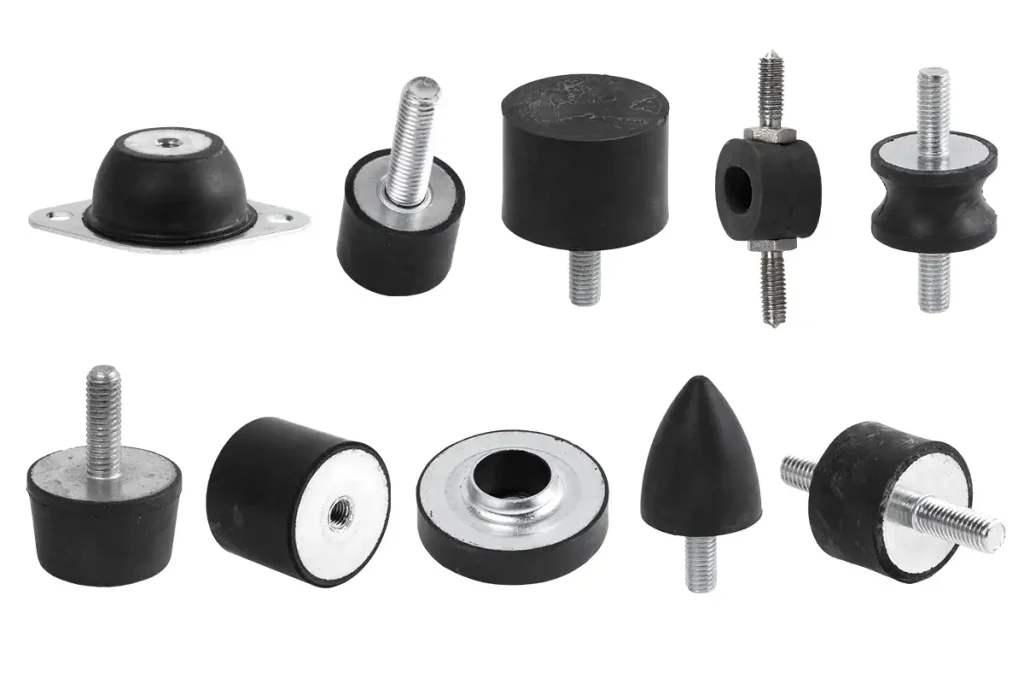
Rubber components
Rubber springs are optimal as vibration and sound dampeners.
The vulcanised rubber elements have a metal-to-rubber bond strength of 130 kp/cm².